


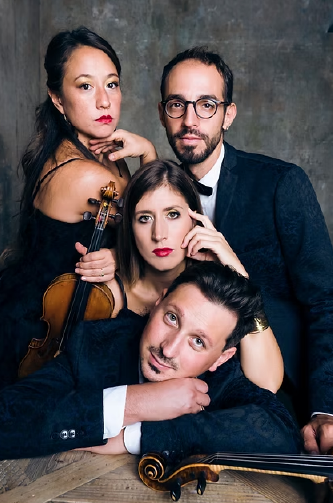
Biography
Eleonora Matsuno, violin
Ida de Vita, violin
Jamiang Santi, viola
Cosimo Carovani, cello
“A splendid richness of sound emerged, flawless execution, perfect balance, and an overall sense of refinement surrounded the performance of the Indaco Quartet, which also demonstrated its ability to project even the faintest whisper of sound effortlessly and to produce vast volumes of sound without a trace of harshness.” — R. Markow
“Compact, full of brilliance and fervor, a true revelation. The Indaco Quartet has arrows in its quiver that hit the target with clear precision, concentration, and great skill.” — Il Giornale di Vicenza
The Indaco Quartet was born to be the ultimate expression of four intersecting paths—roots deeply anchored in the past and in the passions of each of its members. Their love for exploring the diversity of genres and the myriad voices of the present, past, and future is the driving force that the Indaco Quartet brings to every stage, with sincerity, freshness, and dedication. For its members, the quartet is an artistic and social laboratory: a circle that embraces everyone who shares their journey.
On May 18, 2023, after four rounds of competition among ten quartets from around the world, the Indaco Quartet won the Osaka International Chamber Music Competition in Japan, being awarded the First Prize and two special prizes. It was a historic victory: for the first time, an Italian quartet won the top prize at one of the world’s major international competitions, showcasing both the ensemble’s exceptional artistry and Italy’s rising chamber music excellence.
Comprising Eleonora Matsuno and Ida Di Vita (violins), Jamiang Santi (viola), and Cosimo Carovani (cello), the quartet stands as one of the most compelling and versatile ensembles of its generation, asserting itself internationally with authority, vigor, and vitality.
Each member brings diverse expertise spanning teaching, early music, and orchestral leadership. Another distinctive feature of the group is its composer in residence — its own cellist, who writes original pieces and arrangements for the ensemble. Among their key projects is “Moto Contrario,” focused on mental disabilities, supported by the European platform MERITA and created in collaboration with visual artist Letizia Castellano.
Beyond teaching at major institutions, the quartet is devoted to reimagining chamber music by bringing performances to unconventional spaces — such as prisons — and collaborating with schools and companies, using the quartet as a metaphor for listening, growth, and dialogue.
Since 2017, the Indaco Quartet has been the Resident Quartet of Milano Classica Orchestra, where they co-created Qu.B.E. (Quartet-Based Ensemble), a format that merges quartet and orchestral string traditions through new arrangements and explorations.
With a powerful communicative energy and fresh perspective on repertoire, the quartet collaborates with leading artists such as Alexander Lonquich, Alessandro Taverna, Giovanni Bietti, David Krakauer, Mao Fujita, Avi Avital, Julian Bliss, Uri Caine, and Claudia Barainsky.
Nurtured in Italy’s quartet cradle at the Scuola di Musica di Fiesole, inspired by Piero Farulli, and mentored by Oliver Wille (Kuss Quartet), they refined their artistry under luminaries like Günter Pichler (Alban Berg Quartet), Rainer Schmidt (Hagen Quartet), and Eberhard Feltz.
The Indaco Quartet is a Pirastro Artist.
In 2025, they will make their debuts at the Accademia Nazionale di Santa Cecilia (Rome) and Wigmore Hall (London).
- Eleonora Matsuno plays an 1869 J. B. Vuillaume violin once owned by Paolo Borciani, legendary first violin of the Quartetto Italiano.
- Ida Di Vita plays an anonymous 1832 violin.
- Jamiang Santi performs on a 2019 viola by Adam Stalmach.
- Cosimo Carovani plays a c.1840 Charles Claudot cello.